
The other day I went to a gin festival and spoke to one of the distillers there who were saying how same-same social media marketing was. In fact, they mentioned that a number of distilleries had actually dumped a social media agency because they were doing the same thing for all of their clients. I had me wondering about the expectations small business owners have around social media marketing and it led me to this unpopular opinion piece.
So you know, I’ve run social media for a variety of industries and from micro-business through to small business and national chains. I’ve run organic and paid social media and I’ve managed, and re-educated, a number of common beliefs around social media. It’s those that I want to run through here.
I only need social media to be successful
Back in 2011, when I started my first online business, I started on Facebook. Within 5 months I had built a website. Yes, I was getting sales through Facebook, but the process was incredibly manual. In 2014, when I moved into consulting, I started on Facebook and ran events through there. Within months I had a site.
Only having social media limits how your clients can find, follow you, & engage with you. Yes, they can follow a website – especially if you blog.
It also assumes that people go on social media to buy or solve a problem they have. I don’t know about you, but most of the shopping we do and problems we look to solve online are done on a website that’s not social media. (I’m not alone, Google is the main one)
Can’t afford a website? There are a lot of platforms where you can build and host a site for very little (try Shopify, Squarespace, or Weebly). At the very least, set up a Google My Business listing for your business and post there so that Google knows you exist past the ‘home page’ of your business social media account.
Social media posts have to make sales
Please do more than one thing on social media, don’t only sell to us. I want to know more about your business than what you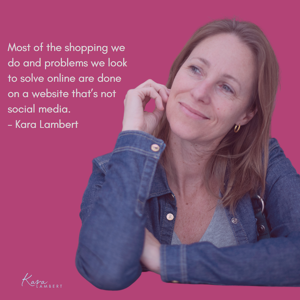 offer. I’d like to know what other people say about what you sell. Why you got started. Who you are. Some behind the scenes.
When all we see is businesses selling to us, we just continue to doom scroll past. It’s not standing out.
Oh and by the way, offering a discount or some other bonus might catch us from time to time, but it will also catch the people who never pay retail and are more likely not to be your ideal client. These people will send you broke.
Back in 2020, 82% of Australians said they follow brands on social media. 68% of Australians read online reviews or blogs for opinions and they will read an average of 7 reviews before making a purchase. Then, just over 60% went on to purchase online.
If you’re going to just sell, make sure there’s a regular post that contains a review. We are doing our homework about your business on your social media, BEFORE we’re ready to buy.
The more followers I have the more successful I am
Can I have a dollar for every time I’ve had to educate a client about not needing to buy fans? Or that they were only a success online once they’d achieved x number of followers. Unless you are an influencer (and by the way, 63% of Aussies said they were less likely to use a brand if they were using a social influencer or celebrity in their marketing) the number of followers doesn’t really matter.
I am hearing of an increasing number of businesses who are getting new clients who have stalked their social media without being a fan or engaging with their content. Isn’t it the new client that’s important then? And doesn’t that make the recorded number of followers you have irrelevant? (Answer: yes & yes)
The number of impressions/reactions matter
OMG, I posted and no one commented or reacted! This is a common catch cry I hear from clients coming to me to understand the psychology of their audience.
Here’s the thing, how often do you interact with posts or reels you see? You will watch, listen, read, and look and then scroll. We all do. So why are we so concerned with the number of impressions or reactions we get?
As a business coach, I will often receive messages or bookings from people who have been consuming my social media content for years – and this will be the first interaction we have. In my industry, it’s common for people to be uncomfortable with showing the wide world, or worse their friends/family, that they are interested in or feel a need to use my services. Sure I’d like the social proof of interactions on my content, but it doesn’t pay the bills.
So again, unless you’re an influencer (and I encourage you to reread those stats I just mentioned about Aussie trust of influencers) then stop chasing followers, impressions, reactions, or interactions – they don’t pay the bills.
Social media is so easy my teenager could do it
Yeah, nah. Sure, your teenager (or the younger members of your staff) are likely to use social media but will they use it the way your ideal client wants to be engaged online?
The aim of marketing is to engage and then motivate your ideal client to take action. Unless your marketing team understands what engages and motivates your ideal client, then you’re wasting time and money.
As a Mum of two teens, I know that they are unable to engage my ideal client (small business owners aged 40+) because their skills focus on their needs. Teenage brains really aren’t wired any other way. So unless you’re prepared to only ask them to schedule content for you, best not to have your teenagers or youngest staffers (unless they’ve been trained) to manage your social media content.
My social media only has to look good (the holy grid of 9)
To a degree. Your social media should be readily identifiable through colours, fonts, and tone of voice. Other than that, your social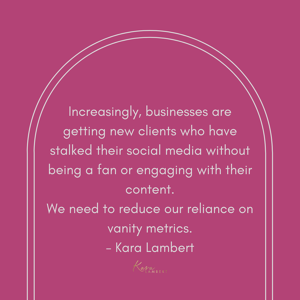 media needs to appeal to what motivates them.
The majority of your audience’s time is spent in the feed. They are unlikely to go to your Instagram account and judge you on the grid of 9 that they see.
They will go to your account/page and make sure that you have a header/profile image and that they can access your shop (either physical address or web address).
You shouldn’t post the same thing on different platforms
Algorithms! Each platform has its own algorithm and you have no idea when or if your content will appear in their feed. You also have no idea if something will be scrolled over on one platform and consumed in another because of the change in motivation in your audience.
People will consume content they find relevant and engaging. No matter where they see it. Or how often. You don’t know if they’ve scrolled past before and it’s only now that it has caught their eye.
We also need to see things more than once to grasp the full content. People may interpret your post differently at different times.
You shouldn’t repeat posts
You shouldn’t repeat bad content. You can repeat relevant and engaging content.
I use evergreen content and I know that I will have different people react to a post when it repeats. You will never know where someone is in their buyer journey. Not repeating content guarantees you will miss them when that content is relevant to them.
As I mentioned in the previous post, we need to see things more than once to understand.
Generally, people consume so much content on social media that they are unlikely to remember that you have repeated the post – provided you post often. I will remember you posting the same post last week if you only post once or twice a week. I will not remember you posting the same post in three weeks if you post four or more times a week.
I hope this post has helped bust a few of the common social media myths you may have heard. Please remember that the focus of your social media content needs to be on your ideal clients’ motivators (psychology). I encourage you, if you are new to this, to access the free video training below. It will explain other common social media errors that psychology solves.